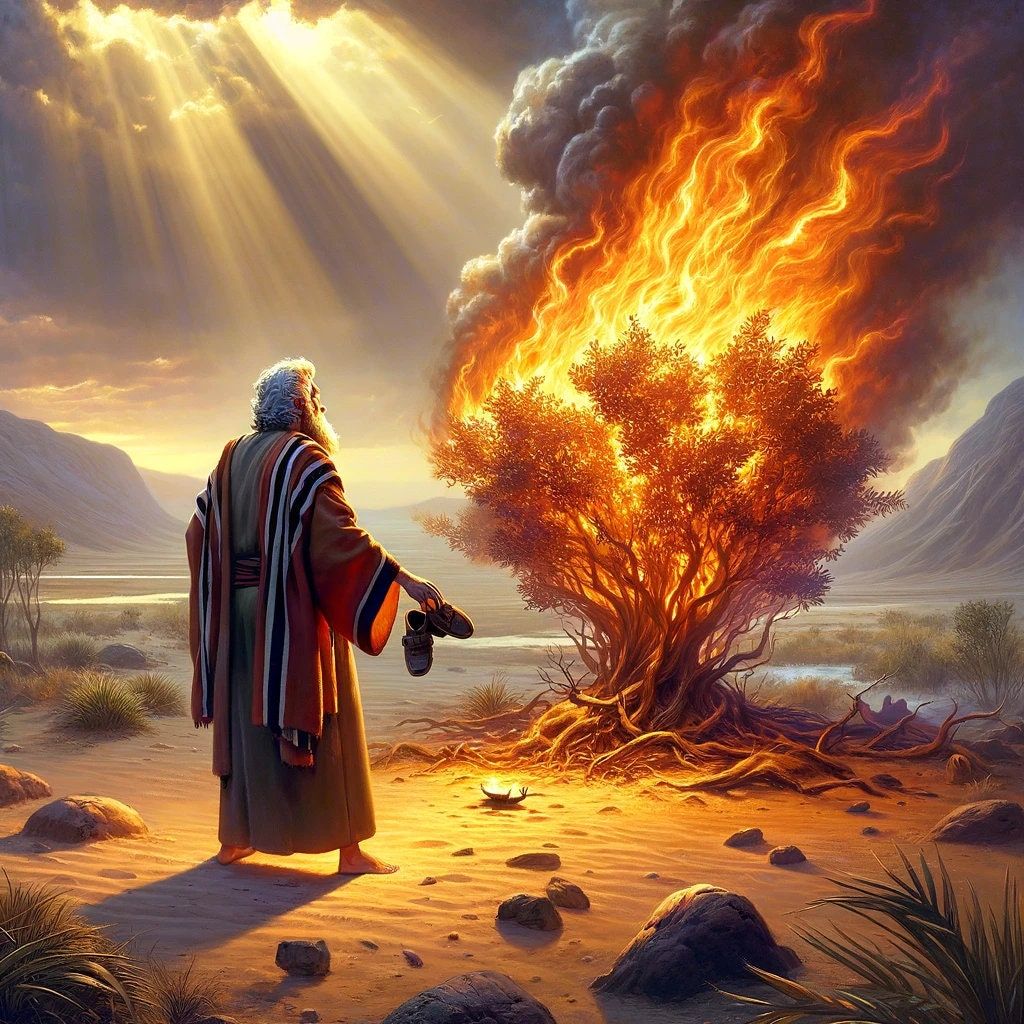
Moses stood on Mount “Horeb,” the second highest mountain in Egypt, also known as “Sinai.” He was nearby grazing the flock of his father-in-law Jethro, priest of Midian.
God draws us to Himself, always in different and original ways, He had chosen that mountain to manifest Himself to the man He chose to deliver His people, that mountain was then called, the Mount of God.
And behold, the Angel of the LORD appeared to him in a flame of fire in the midst of a bramble bush, which though burning was not consumed. Now the LORD saw that he had moved to see, and God called him from the midst of the bush and said, Moses, Moses. He answered, Here I am, God said, do not come near here; take off your sandals from your feet, for the place on which you stand is a holy place.
This episode is described to us in the Old Testament, exactly in Exodus 3:4-6. Moses must keep his distance; get close, yes, but not too close; close enough to listen, but not so close as to pry. Care must be taken that the intimacy with God sought, does not generate little reverence.
Moses’ experience, begins by dialoguing with his own God, who transmits His laws for the people. We note that no one could approach the mountain but Moses, who from there on will become God’s mouth to speak to His people, although later the mouth will become his brother Aaron, while Moses will be like a God to him. “You shall set bounds all around the people and say, Beware of going up the mountain or touching its extremity. Whoever touches the mountain shall be put to death.” (Exodus 19:12). Then the LORD commanded Moses to come down from the mountain and report to the priests and the people not to rush to go up to the LORD, lest He come against them. The time came, however, when God spoke to Moses again, saying, “You have dwelt near enough on this mountain ; lift up your tents, set out and go to the mountainous region of the Amorites, pointing out places as far as the land of the Canaanites and the river Euphrates .”
It is important to know that whenever we approach God, we must be keenly aware of the infinite distance between us and God: “Do not be hasty with your mouth, and your heart do not hasten to utter any word before God, for God is in heaven and you on earth;” (see Ecclesiastes 5:2). This could also be interpreted as rigor belonging to a past period of darkness, bondage and terror, from which the gospel of grace frees us by giving us that freedom to enter the holy place, thus inviting us to approach peacefully.
However, taking off one’s shoes meant then what taking off one’s hat can mean today, a sign of reverence, respect and submission. The ground now is sacred ground, made so by the divine presence, so do not walk on this ground with dirty shoes.
“Watch your steps when you go to the house of God; draw near to hear rather than to offer the sacrifice of fools, who do not even know that they are doing harm.” (Ecclesiastes 5:1).
Note that: We should approach God with great caution and proper preparation before such an encounter, since we are about to glorify God, not only with our spirit, but with our whole being: “Bless my soul, the LORD; and all that is in me bless His holy name.”, (Psalm 103:1). Our behavior therefore should be serious and reverent in rendering our celebration to God, carefully avoiding anything frivolous, vulgar and unbecoming compared to the majesty of such a celebration.
There is a time when God’s children, glorify His holy name, which means to present their holiness before His presence, as Paul writes to the Hebrews, “Let us draw near with sincere hearts, in full assurance of faith, having our hearts aspersed (i.e., sprinkled) to cleanse them from an evil conscience and our bodies washed with pure water.” (Hebrews 10:22). Not to present ourselves in such a condition is to be hypocrites, and besides wasting our time, besides being like a dirty cloth in the midst of the assembly of the saints, we offend God, for it is written, “But he, answering, said to them: “Well prophesied Isaiah of you hypocrites, as it is written, ‘This people honors me with their lips, but their hearts are far from me.'” (Mark 7:6; Isaiah 29:13) . There is also a time when it is God to glorify His name, that is, to show His Purity and Holiness to the people. Beware, however, praying and invoking the name of the LORD, asking to glorify His name in the assembly, may even result in death if He does not find the holiness He expects. In fact, we find several examples in the Old Testament: The LORD commanded that the Ark in the tabernacle be hidden by a veil, and He advised Moses to warn his brother Aaron, who though designated as a priest along with his sons Nadab and Abiu, not to enter the sanctuary at any time, beyond the veil in front of the propitiatory that is on the ark, lest they should die. (Leviticus 16:2). Later on we will unfortunately see an unfortunate event, that the very sons of Aaron: Nadab and Abiu,(in Hebrew נדב, Nadav, and אביהוא, Abihu), each took his censer, put fire in it, placed incense on it, and offered before the LORD foreign fire, different from what He had commanded them, this was paid for with the price of their lives, before the LORD, their father Aaron and uncle Moses. Now we know that fire represents the Word of God, while incense represents the fragrance of the prayer of the saints. For we see that the Angel of the LORD to proclaim His Word, appeared in a flame of fire, (Exodus 3:2) ;
“Now Mount Sinai was all smoking, because the LORD had descended upon it in fire,” (Exodus 19:18);
The LORD commands that sacrifices be smoked over an altar as a perfume, by means of fire, (Exodus 29:18-25);
“Then the priest shall cause part of the grain and part of the oil to be smoked as a memorial, with all the incense. It is a sacrifice made by the fire of the LORD.”, (Leviticus 2:16);
“The way of God is perfect; the Word of the LORD is purified with fire. He is the shield of those who hope in him,” (2nd Samuel 22:31);
“Then I said, ‘I will mention her no more and speak no more of her name.’ But His Word was in my heart like a burning fire, locked in my bones; I strove to contain it, but I could not.”, (Jeremiah 20:9);
“Then one of the seraphim flew toward me, holding in his hand a burning coal, which he had taken with springs from the altar. With it he touched my mouth and said, ‘Behold, your iniquity is removed and your sin is atoned for,'” (Isaiah 6:6-7).
As for the fragrances, we know that these pertain to the prayers of the saints, we need only read in Revelation 5:8: “And when he had taken the book, the four living creatures and the twenty-four elders prostrated themselves before the Lamb, each having a zither and golden cups full of fragrance, which are the prayers of the saints.”
Throughout the Bible, “The Word,” is represented by various symbols such as: the Bread, the Water, the Fire, the Seed, the Sword; This is because our God has chosen to communicate with people: in parables, in symbols and in similes, but only to those who approach it with true interest and humility of heart will the mysteries be revealed to them.
And what shall we say of the priests sons of Eli: Hofni (חָפְנִי) and Finehas פִּינְחָס. who while living a perverted and corrupt reality, heedless and wicked, continued their office as priests of the LORD, but the sad day came when he put them to death together with their father who never knew how to take them back with strictness. (Numbers 3:4) .
How sad and how grave a danger when the priesthood is dishonored, as it is carried out out of self-interest, or out of habit and superficially, as if it were an ordinary secular job. Let us remember that the Lord has made us priests and kings by God the Father. (Revelation 1:6). While the priests of that time, were assigned a material thurible, in which they put fragrant incense to be shaken before the altar, we have been assigned a spiritual one, which resides in our hearts, inflamed by the Word of God, which offers to it as a fragrance, the pure and sincere praise and adoration that is due to Him.
Beware, then, of confusing the sacred fire, with attitudes conditioned by emotions and short-lived mass involvements. Woe to confuse holiness in the assembly of a mature Church, with a gathering as if one were at a movie theater: everyone enters when they please, leaves when they please, dresses as they please, chats as they please, “participates” as they please. I wonder who would show up at a wedding with shorts and flip-flops on their feet, and if they do, they think that so much the Lord knows their heart, well, know that this is a worn-out answer, of course God knows the hearts of men, in fact we manifest what we really are, do you therefore estimate that honoring a wedding, is more solemn than celebrating the Eternal ?
Not even presenters are exempt from the Lord’s discipline. In the past, I have found myself sitting next to pastors who until just before the service to be rendered to the Lord opened, chatted about vain things with some laughter, soon afterwards they would go up to the pulpit speaking in tongues and also bring a message that charmed the church bringing it to ovation, and the response of the church was a hearty applause of approval. After time, I would see another pastor sitting in a corner, with his head between his legs, silent, his eyes closed, not wanting to lose the communion he brought from home, and I would see him in pain when someone went to greet him, thus interrupting his prayer. Well, the time would come when he would bring the same message as the much applauded pastor, the church this time was in reverent silence, many wept, at the end no applause. I remember of a testimony, of a similar event, that the one who was presiding exclaimed, “Earlier I heard a beautiful sermon, now, I recognized the author of that sermon.”
One day before I went up to the pulpit to preach, one of my spiritual fathers told me, “When you speak, look at the church, see if they are receiving, if that message is appropriate for that day, if not, change the tone or subject, if not, close the preaching.” I didn’t understand that saying so much, today, I think that beloved brother was way off base. Woe to preach what the church wants to hear, woe to want to flaunt a charisma, assuming the attitude of a leader, we would end up like Nadab and Abiu, maybe we won’t be electrocuted on the spot, but on the last day, we will hear that chilling word, “I DON’T KNOW YOU !” . Rather, don’t preach, speak only when the Lord commands you, and never change the message He has given you to shepherd the Church, unless, He Himself does it.
Remember how Paul writes to the Hebrews: “For the Word of God is living and efficacious, sharper than any two-edged sword, and penetrates to the division of soul and spirit, of joints and marrow, and is able to judge the thoughts and intentions of the heart.” (Hebrews 4:12).
If the message conveyed, does not achieve these goals, even for one heart, all has been in vain, perhaps the reward you will receive will be the praise of some simple soul who is content with so little.
I believe that even in our day the Lord’s command has not changed: just as he then told the prophet Ezekiel to sound the trumpet to warn that the sword was about to come into that city, (Ezekiel 33:3); still today he tells his servants to alert the people because one cannot be superficial and irreverent. “They have sounded the trumpet, and all are ready, but no one goes to the battle, for the ardor of my wrath is against all their multitude.” (Ezekiel ,14).
If we ask and do not receive from the LORD, we would do well to ask ourselves whether we are really honoring him with our lives. When Israel rallied to the battle, and King David consulted the LORD, that was a battle won; but when the people went their own way, defeat was bitter and assured, for in one of the battles against the Philistines, Israel losing four thousand valiant men, thought good to go to Sciloh to get the Ark of the LORD, and the sons of Eli the priest: Hofni and Phinehas, were there with the Ark of God’s covenant; all the tribes of Israel gathered at the place of battle, each with his own flag, as if they were one man. When they saw the Ark, all Israel exploded with a shout of joy so loud that the earth trembled, and the Philistines were afraid, but it was all for naught, that day the priests who held the Ark died: Hofni and Finehas, the Ark was taken, Israel was defeated, and on that day alone thirty thousand men died. (1 Samuel 4:10).
Lord, why do you let us know these things ? , why can’t we make our own choices, leading our lives as we please, and then think we are taking our God with us ! “You shall not use the name of the LORD your God in vain, for the LORD will not leave unpunished those who use his name in vain.” (Exodus 20:7).
Taking off one’s shoes was also a way of wanting to humble oneself before God; bare feet testified to an acknowledgment that they were sinful and worthless men. “David danced with all his might before the LORD, girded with a linen ephod. So David and all the house of Israel carried the ark of the LORD with shouts of rejoicing and with the sound of a trumpet. ” (2 Samuel 6:14-15). On another occasion, when David was fleeing from his son Absalom who wanted to usurp his father’s throne, he went up the slope of the mount of olives and, going up, wept; he walked with his head covered and barefoot. And all the people who were with him had their heads covered, and as they went up they wept. (2 Samuel 15:30).
Let us remember that in the Old Testament, in various books such as “Leviticus (23:36),” in the book of “Numbers (29:35),” in “Deuteronomy (16:8)“; the LORD considered the commanded day of the assembly of His people, a solemn day, a day on which no useful work should be done.
In the book of “Judges,” we even find that whoever among all the tribes of Israel did not go up in assembly before the LORD in Mitspah, that such a one was to be put to death, (Judges 21:5). Also in the book of “Nehemiah,” and in that of the prophet “Joel,” proclaiming a solemn fast and assembly was desired by the LORD. In the book of Chronicles it is written: “Celebrate the LORD, call upon His name; make His works known among the peoples. ” (1 Chronicles 16:8); while in verse 34, it reads, “Celebrate the LORD, for he is good, for his goodness endures forever.”
When the Moabites and the Ammonites, arrayed themselves in battle against King Jehoshaphat, he was afraid of that multitude and called out a fast to seek help from the LORD, who, being faithful, answered that he was not afraid, for that battle was not his, but the LORD’s. At the victory obtained, King Jehoshaphat, after taking counsel with the people, determined those who should sing to the LORD and should praise Him for the splendor of His holiness, and as they walked before the army they said, “Celebrate the LORD, for His goodness endures forever,” (2 Chronicles 20:21).
“Celebrate the LORD with the zither; sing to Him with the ten-stringed harp.” (Psalm 33:2).
“Celebrate the LORD, call on his name, make his works known among the peoples,” (Psalm 105:1). “Hallelujah, Celebrate the eternal, for He is good, for His kindness endures forever.” (Psalm 106:1) . The same is written in the book of Isaiah 12:4 and Jeremiah 33:11.
So we will say that throughout the Old Testament, every book tells us how important it is to Celebrate and Praise the Lord with fear, holiness and humility.
The New Testament is no different, the Lord Jesus points out, “Do not think that I have come to abrogate the law or the prophets; I have not come to abrogate, but to bring to fulfillment.” (Matt. 5:17).
There was certainly no lack of words of reproof from the Master… And he said to them, “My house shall be called a house of prayer, but you have made it a den of thieves” (Matthew 21:13).
Apostle Paul, recommends to the church in Corinth: “Do not give cause for scandal either to the Jews or to the Greeks or to the Church of God.” (1 Corinthians 10:32).
Paul again writes to the Hebrews: “Therefore receiving the kingdom that cannot be shaken, let us show gratitude, by which we serve God acceptably, with reverence and awe.” (Hebrews 12:28).
Salvatore Sturniolo