A new system of alliances: from the Eurasian bloc to Africa
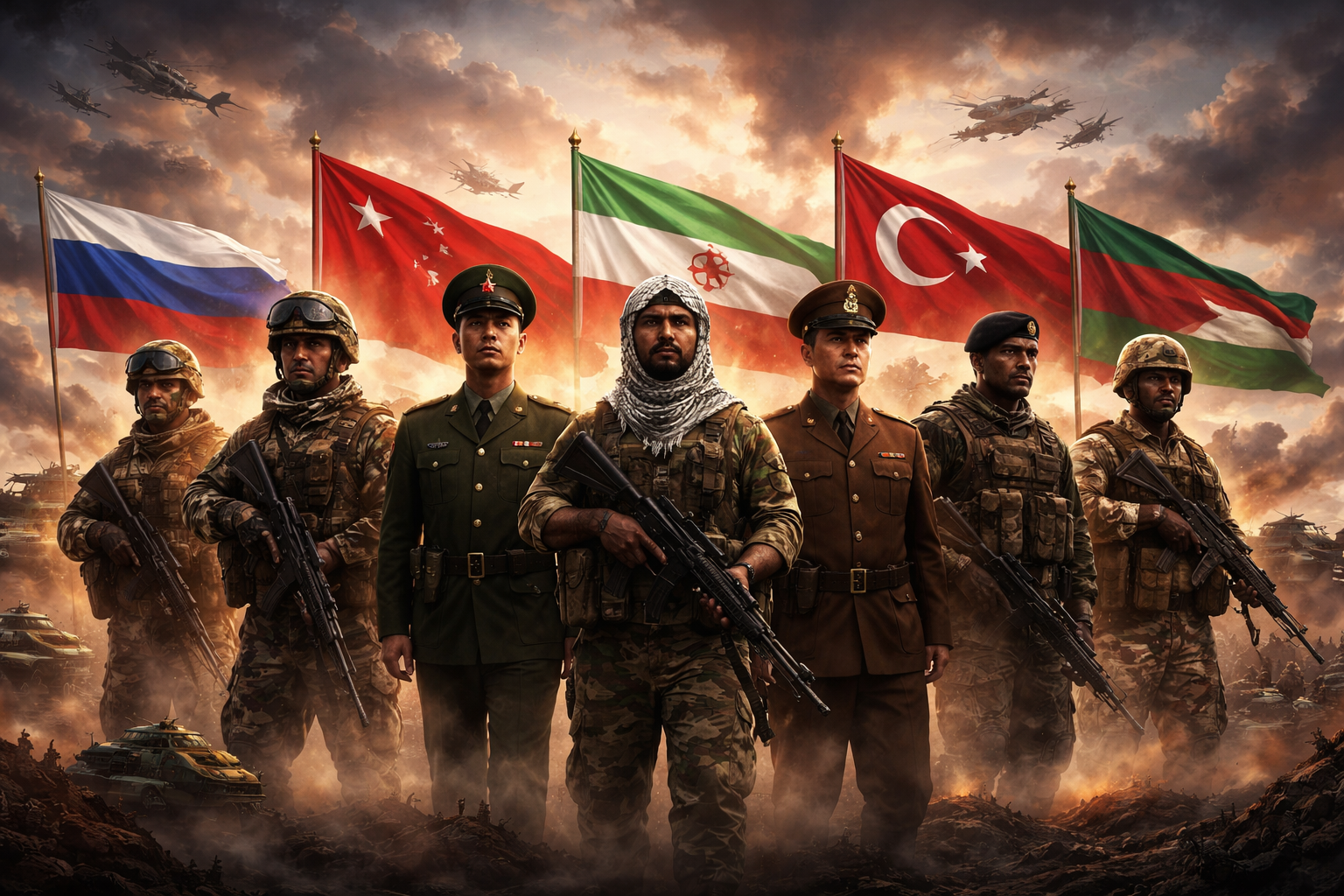
In recent years, a network of strategic alliances and cooperation has been forming that does not resemble a classic military pact like NATO, but rather a flexible system of political, military and economic convergences. At the center of this system are Russia, China, Iran and North Korea, often referred to by analysts by the acronym CRINK. There is no unified command or single multilateral treaty among these four actors. However, there is structured cooperation:
– Russia provides military technology, training and diplomatic cover;
– China supports economically and politically, but avoids direct military commitments;
– Iran contributes drones, asymmetric know-how, and regional networks;
– North Korea offers munitions, missiles and military manpower in exchange for economic and technological support.
This bloc is held together by a common interest: reducing Western influence and promoting a multipolar international order. The most visible projection of this system is seen in Africa, particularly in the Sahel region. Here Russia has strengthened relations with governments and military juntas by offering:
– Armed support and training;
– Regime security consulting;
– Agreements on natural resources and logistics.
These relations are not ideological alliances, but pacts of convenience: internal stability in exchange for strategic access. In parallel, China maintains a more discreet but widespread presence, focused on policing, internal security, training and investment protection, avoiding direct involvement in conflicts.
A key player, often a bridge between different worlds, is Turkey. While formally remaining in NATO, Ankara has developed an autonomous foreign policy:
– military and defense agreements with numerous African countries;
– Sale of drones and military technology;
– Cooperation in intelligence and training.
Turkey is not fully integrated into the CRINK bloc, but it interacts with Russia, Iran and Africa according to a pragmatic logic, becoming a connecting actor between Eurasia, the Middle East and the African continent.
Iran maintains a less visible but strategic presence in some African areas, especially where security gaps or international isolation exist. Here it exports models of control, low-cost military technology and limited but functional ideological relationships.
A system of deployments, not a unified front
Overall, what emerges is not a “compact bloc,” but an ecosystem of overlapping alliances:
– Military cooperation without full integration;
–Converging but not identical interests;
– bilateral relations that can strengthen or cool rapidly.
This makes the system less predictable, but also more resilient: if one link weakens, the others remain operational. The situation in Africa further reinforces this system of cooperation in that Africa with its territories rich in mineral resources and its geographical position is for the Euro-Asian powers an essential and indispensable base for establishing dominance over the Western powers .According to this very important development scenario and following this view, the following is a cautious and up-to-date list of African nations that are aligned or cooperating (militarily, politically or in security) with the bloc CRINK (Russia-China-Iran-North Korea). This is not a formal alliance; we are talking about de facto alignment, cooperation or strategic dependence.
Africa – Countries most closely aligned with the CRINK bloc.
– Mali
Direct military cooperation with Russia; presence of instructors and armed support; break with Western partners.
– Burkina Faso
Political alignment with Moscow; military cooperation and regime security.
– Niger
After the coup, progressive rapprochement with Russia and China; exit from Western orbit.
– Central African Republic
Case in point of dependence on Russian security; structural military cooperation.
– Sudan
Military cooperation with Russia and Iran; strategic Red Sea supplies and interests.
– Libya
Russian presence and influence in some areas; fragmented and non-unified context.
– Algeria
Historical military partner of Russia; strategic cooperation while maintaining diplomatic autonomy.
– Ethiopia
Political and military relations with Russia, China and Iran; resistance to Western pressure.
– Eritrea
Anti-Western political alignment; cooperation with Russia and China.
– Angola
Strong economic and infrastructure dependence on China; political cooperation.
– Zimbabwe
Established relations with China and Russia; isolation from the West.
– Mozambique
Security cooperation with Russia (past) and strong Chinese presence.
In essence, these are military or authoritarian governments with anti-Western sentiments, where there is a perceived need for security of the authoritarian regime, and where there is significant access to strategic resources . In this scenario, the willingness of Russia and China to provide support without political conditions is a given. Studying the resource map and geographic location of African nations explains why the CRINK alignment in Africa is more concentrated in the Sahel, Horn of Africa, and some strategic nodes in North Africa.
The emerging world is not divided into two rigid camps, but traversed by fluid power networks, where Russia, China, Iran, and North Korea act as catalysts, Turkey as a bridging actor, and Africa as a central space of strategic competition.
It is precisely this combination of the Eurasian North, the Middle East, and Africa that has led many observers-especially in biblical-prophetic circles-to note structural similarities with ancient descriptions of multi-regional coalitions. But beyond interpretations, one thing is certain: the world has changed, and the alliances of the 21st century no longer follow the maps of the 20th century.
Is it really the deployment of the end times?
Listening to and reading the latest news about the encounters between the great powers and the attempts to secure access to the great mineral and strategic resources, one sees a striking resemblance to the arrangements spoken of by the Prophet Ezekiel, one of the major prophets of the Old Testament and the author of the Book of the same name who lived in Jerusalem between about 620 BCE.C. C. and 570 B.C. In his book, chapters 38 and 39 , a great coalition of peoples is described moving against Israel “in the last days” (Ez 38:16). The prophet speaks of Gog, from the land of Magog, defining him as the one who comes “from the uttermost parts of the north” along with many allied peoples (Ez 38:6; 38:15). Among them Persia, Cush and Put are explicitly mentioned:
“Persia, Cush and Put are with them, all with shield and helmet” (Eze 38:5).
The picture that emerges is not of an isolated nation, but of an interregional coalition involving the North, the Middle East and Africa, united by converging interests rather than a common ideology. The motivations attributed to this alliance are also significant:
“You will go up against my people Israel…to loot and plunder” (Ez 38:12).
Many interpreters note that this description seen as a leading Northern power, flanked by Eastern and African allies, acting in a context of global instability, bears strong structural similarities to today’s geopolitical alignments, which are characterized by fluid cooperation, strategic goals, and material interests. However, the biblical text also emphasizes that the final outcome does not depend on the strength of the coalition, but on God’s direct intervention:
“I will manifest my greatness and my holiness … and they will know that I am the Lord” (Ez 38:23).
Ezekiel’s concluding message is thus not only geopolitical,: at the climax of history, when nations seem to converge into a global array, ultimate sovereignty does not belong to human alliances. Whether or not the current world configuration represents the prophesied scenario, the parallelism invites reflection on the fact that power dynamics, already glimpsed in antiquity, tend to recur when the world enters a phase of profound transition.
In this discussion, it may be possible to share the view of many scholars that chapters 38 and 39 of the book of Ezekiel describe a literal, future event placed in the last times, just before or at the beginning of the end times, preceding the reign of Christ who returns and reigns over all the earth.
1) The time of prophecy: “in the last days”
The text explicitly indicates the time location:
“It shall come to pass in the last days: I will lead you against my land” (Eze 38:16)
According to the interpretation, this reference is not about the return from the Babylonian exile, but about a final and therefore apocalyptic time, when Israel returned to its land and became a nation again (an event seen as realized in 1948).
2) Gog and Magog: the leader of the Great North.
Gog is described as:
“prince of Rosh, Mesec and Tubal” (Ez 38:2).
Many interpreters identify:
– Magog, Mesec and Tubal with territories north of Israel
– Rosh as an etymological reference to a dominant northern area
Hence the widespread identification of Gog with a “Northern” power, often associated with modern Russia. This identification is not based on a single verse, but on:
– geographical direction (“extreme parts of the north,” Ez 38:15);
– leading role in the coalition;
– Territorial continuity of ancient peoples.
3) The allies: Middle East and Africa
The biblical text clearly lists allies:
“Persia, Cush and Put are with them” (Eze 38:5).
“Gomer and all his hosts, Bet-Togarma…” (Eze 38:6).
In the reading there is a strong corrsipondence ::
– Persia = Iran (direct historical identification);
– Cush = regions south of Egypt (Ethiopia/Sudan);
–Put = North Africa (traditionally Libya);
– Gomer and Bet-Togarma = Anatolian/Caucasian area (often associated with Turkey).
The key point is not just who participates, but the fact that it is a broad and coordinated coalition, uniting North, Middle East and Africa.
4) The motivation for the invasion
According to Ezekiel, the attack occurs when Israel is living in relative safety:
“You will go up against a quiet people…to loot and plunder” (Ez 38:11-12)
One can easily interpret this verse as:
– An attack not defensive, but opportunistic;
– motivated by economic, strategic and geopolitical interests;
– fostered by an environment of apparent Israeli stability.
5) The outcome: direct intervention by God.
Central element, however, is that Israel does not win on its own strength:
“I will judge Gog… with plague, blood, torrential rain, hail, fire and brimstone” (Ez. 38:22)
The destruction of the coalition serves a specific purpose:
“The nations will know that I am the Lord” (Ez 38:23).
This event is seen as:
– A public demonstration of divine sovereignty;
– A turning point that prepares for the final events
Because we find parallels with current times .
Basically, some structural, not chronological, coincidences are noted:
– Israel’s return as a nation;
– Emergence of a hostile Northern power;
– presence of Iran and African actors in the same axis;
– pragmatic alliances, not ideological ones;
–growing hostility toward Israel.
Therefore, we feel we join the view of many scholars who say not that Ezekiel 38 is “already happening,” but that the conditions described are taking shape. We have waded into this ocean of considerations, which opens a world to speculation and debate that needs more installments of this column . But we stop here . But we invite our readers to reflect on the fact that these extraordinary correspondences confirm what the Lord Jesus said (Mt 24:44 ) : Therefore, you also be ready; for in the hour you do not think, the Son of Man will come .
Francesco Pastone