Listeners:
Top listeners:
-
play_arrow
La Carovana Evangelica
Glossolalia in the Bible and in Christian Life — Part 1
In these days of confusion, bewilderment, and fear, immense crowds who until yesterday had shown the most cynical indifference toward God are making the great “return.” Every corner of the world has been reached by the life-giving breath of the Spirit, and in every sphere of society the yearning of the soul finally returning to God is reemerging.
This immense spiritual phenomenon is not a return to “traditional religiosity” or a rediscovery of the church, the liturgy, or sacramental practice, but simply a deep desire—indeed, an imperious need—for God. In other words, believers do not feel the need to find a new place within their church, or once again to take part in religious life with all its practices and ceremonies, but only to experience true, tangible communion with God: they want the reality of His presence in their lives; they want the evidence of the supernatural in their experience.
We cannot be surprised if, as a result of this yearning, these immense crowds of believers have desired and sought a charismatic life—or, as others have called it, a Pentecostal life. All have forgotten the position of severe criticism they held for decades toward those revival movements which, in our century, brought Christian charisms back to life within their own ranks—that is, the gifts and manifestations of the Spirit. All have forgotten, in order to set out in search of those very gifts and to relive exactly the same experience.
We who have been the object of criticism—and not only of criticism—can rejoice at this change and give praise to God, whose arm is still, and always, outstretched to save, to work, and to manifest all His power. Our particular position, however, also makes us feel the duty to offer those counsels which, founded on Scripture, may draw upon the authority and light that come from experience, and may therefore be of real help in the exercise of the charismatic life.
Without the slightest trace of presumption, we wish to address all those who recognize the need to deepen their Pentecostal experience, even doctrinally, and to prevent it from degenerating into a mere emotional phenomenon or being reduced to a sterile sensation.
The subject is vast in scope, but for now we shall limit ourselves to narrowing it down to the study of one particular aspect of the charismatic life: the gift of tongues (glossolalia). This is also because, rightly or wrongly—and we hope to determine this from our study—this phenomenon appears to be a central component of the Pentecostal revival.
In the hope of doing something pleasing to all believers, and especially of offering a fraternal word of clarification to those who are called “charismatics,” “neo-Pentecostals,” or “Pentecostals,” with the addition of the most varied denominational definitions—which often, when they do not unsettle us, leave us perplexed—we lift up a prayer that the wind of Pentecost may sweep away all those things which, as intrusive elements, seek to hinder the revival in our generation.
Perhaps we too need a clarifying word to help us penetrate the essence of the problem, in order to remove those reservations or resolve those perplexities that arise from the multiplication of elements which make it increasingly difficult to place the components of all the movements mentioned in a coherent framework. Have the yearnings, aspirations, and searches been directed toward an authentic spiritual revival? Are the experiences and phenomena all genuine manifestations of the Spirit?
While offering a word of counsel, we seek to shed light—for others and for ourselves—on this fascinating subject.
Glossolalia in the Bible
“Glossolalia,” or the “gift of tongues,” is presented by the Bible as a component of the charismatic life of the church. In the Pauline catalogue contained in the Epistle to the Corinthians, it finds its place among the gifts that confer supernatural ability to speak.
All spiritual gifts confer supernatural abilities; that is, they manifest themselves through believers not by disregarding, but by surpassing their personality. Intelligence, action, and speech, when they spring from the Spirit, make the Christian an instrument that carries out the supernatural work of God.
Glossolalia may be considered among the gifts that most clearly and directly demonstrate the supernatural nature of their essence, because it enables the believer to express himself in “tongues” unknown to him, without the intervention of intelligence or culture.
The spiritual phenomenon cannot be studied and understood by means of medical, psychological, or philological science, because it belongs to the sphere of the divine, where the sovereignty of God is expressed “outside and above” the spiritual laws known to man. The attempts made by the various scientific disciplines to interpret the phenomenon have always proved ineffective.
“Glossolalia,” then, is that spiritual gift which “takes the place” of the believer’s tongue and enables him to express himself in a “language” unknown to him. Obviously, this “substitution” also directly involves the mind, because the “spoken word” is simply, and for everyone, the manifestation of thought.
The glossolalist, however, speaks but does not understand his own discourse, his own words, because they are “his own” only within the limits of the use of the vocal cords and the emission of breath—that is, within the limits of “physical participation.” Naturally, what is truly his own is his spiritual willingness.
To be used by the Spirit implies the realization of an experience which, even though it is not rational, is nevertheless edifying and upbuilding. “Speaking in tongues” by the Spirit therefore constitutes, as we shall see more clearly later, always a blessing.
That man may suddenly speak in a language unknown to him is generally admitted by many, but the phenomenon is interpreted in the most diverse ways, also because—we must acknowledge it—it occurs in the most varied spheres of spiritual life and in the most varied forms. But in this brief and modest writing, I intend to address “exclusively” the problem of glossolalia in relation to the charismatic life, in the light of Scripture, and therefore disregarding the studies that have been carried out to approach the subject from secular points of view.
Already in the first book of the Bible, God’s intervention among men is briefly described, when they had planned the construction of a city and a tower that was to reach up to heaven. The ambitious project could not be approved by God, who declared:
“…let us go down and confound their language, that they may not understand one another’s speech…” (Gen. 11:7). There the Lord confounded the language of all the earth (Genesis 11:9).
The exegesis of the passage may lead us to conclude that in Babylon each person understood himself, but no one understood the other. In any case, a people who until that day had been united by a single language suddenly became the source of the most diverse tongues.
We certainly cannot identify the “gift of tongues” with the miracle of Babylon, or vice versa; yet we can observe that when the “divine” enters into the human, those phenomena may occur which many stubbornly insist on wanting to understand and explain on the level of reason.
After the passage just mentioned, the Bible no longer speaks explicitly of the miracle of tongues. Personally, I reject the interpretation of some who wish to see in Deuteronomy 28:49 a reference to glossolalia. This passage may be placed in parallel with Isaiah 33:19, Psalm 81:5, and Jeremiah 5:15: these are clearly references to foreign peoples whose language cannot be understood in Israel precisely because it is “foreign,” yet it is a language well understood by the peoples who speak it.
In the First Epistle to the Corinthians, Paul quotes a passage from the “law” which represents a prophecy concerning glossolalia. It seems that by “law” the Apostle means the “Old Testament,” because the only passage that can be considered as corresponding to the one quoted in the Epistle is the one found in the prophet Isaiah: “With stammering lips and with foreign tongues He will speak to this people” (28:11).
But even this prophecy remains wrapped in that obscurity which characterizes announcements of realities that can receive their precise explanation only when they are fulfilled.
We cannot exclude the possibility that glossolalia may also have had a place and a manifestation within prophetic circles, especially when collective ecstatic phenomena occurred (1 Sam. 19:20–24). But this remains in the realm of hypothesis, and we must honestly acknowledge that a historical reconstruction cannot be made on the basis of personal conjectures.
Indeed, we wish to note that not even Joel, defined as the prophet of the Holy Spirit, who nevertheless dwells on spiritual experiences and gifts, makes mention of glossolalia.
These observations explain why the subject, being scarcely documented biblically, raises so many perplexities among those students of Scripture who, lacking direct charismatic experience, seek at least the aid of an abundant clarifying literature in order to understand, and therefore explain, the subject itself.
The Old Testament is sparing in quotations useful for exploring the problem in depth, and the New Testament is concise; nevertheless, it provides us with all the indications needed for an understanding—even a theological one—of a spiritual experience that becomes completely clear when the believer realizes it and is able to compare it with Scripture.
The four Gospels set forth the doctrine of the Holy Spirit, complementing one another; they make known to us that He guides, reveals, and speaks on behalf of the believer. The Spirit convicts the world of sin, comforts the faithful, defends them, can be received in ever more abundant “measure,” and is given to all those who desire Him and ask for Him (Luke 11:13; John 7:37–39).
The evangelist John recalls the Master’s most solemn declarations concerning the Spirit: “If anyone thirsts…”; “He who believes in Me, out of his innermost being shall flow rivers…”; “It is expedient for you that I go away… the Comforter will come to you”; “He will guide you…” (John 7:37–39).
Despite this abundance of study material, the only reference to “glossolalia” is found in the final chapter of the Gospel of Mark and, what may seem surprising, not in reference to the subject of the Holy Spirit, but to that of faith: “These signs shall follow those who believe… they shall speak with new tongues” (Mark 16:17).
I wish to point out at once that glossolalia is indicated as a “sign” identifying the believer, and not as a “sign of recognition of the baptism of the Holy Spirit.”
Believers present to the world, together with their regenerated life and their luminous works, the evidence of an active faith: exorcism, healing, and glossolalia, joined to a miraculous invulnerability that will preserve them from the poison of serpents or from deadly drinks.
I cannot close this parenthesis without adding that this verse of the Gospel of Mark illustrates a collective, not a personal, condition; the supernatural operations therefore represent the heritage of the church, constituted by the blending of the gifts and experiences of individual believers (1 Cor. 12:11–30).
This clarification is not yet intended to address the problem of the relationship between baptism in the Spirit and glossolalia, but rather to emphasize the first New Testament passage concerning our subject.
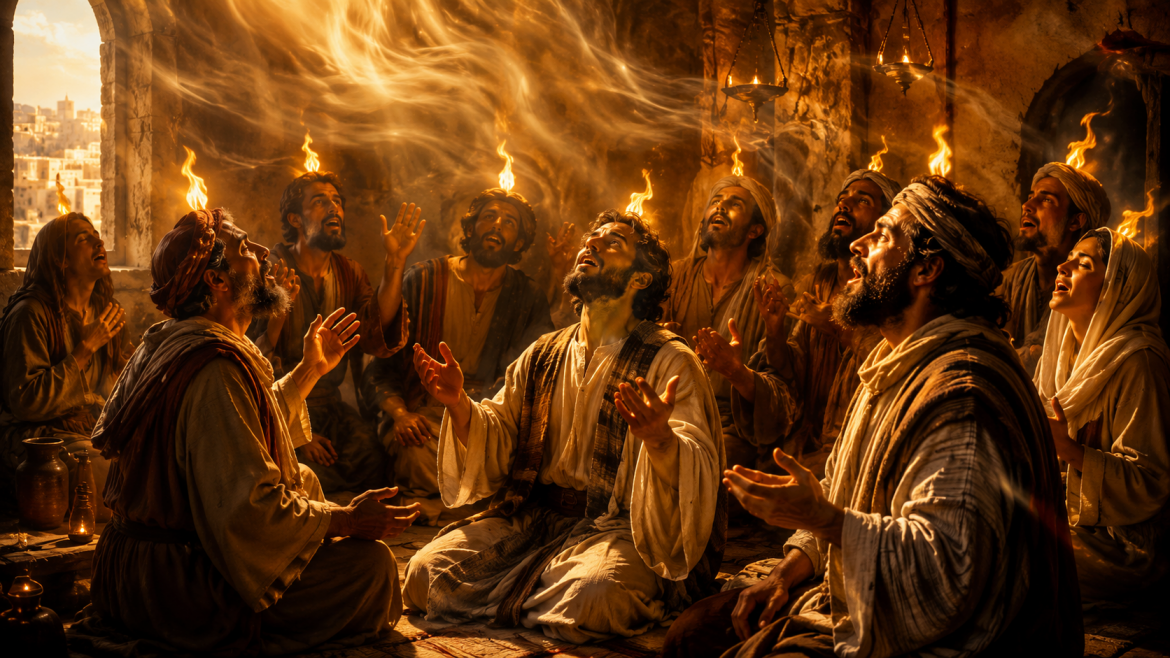
We must come to Acts 2:4 to find the next passage, and this brings us fully into the subject, because it describes the experience of the Christians gathered in the Upper Room in Jerusalem.
I believe that this passage is the most exhaustive, not only in its description of the phenomenon in the apostolic age, but also in illustrating both its formal aspect and its substantial contents.
I wish to recall that the title of this writing is “Glossolalia,” and therefore I cannot yield to the invitation to expand it beyond its natural boundaries in order to enter into the enticing articulations of the theology of the Holy Spirit. Yet I cannot avoid a brief exegetical analysis of the words of the passage cited and of those of its context.
The Christians in Jerusalem “began to speak in foreign tongues, as the Spirit gave them utterance,” after they “were filled.” It is also useful, however, to recall the very rapid sequence of events that followed one another on the day of Pentecost: “from heaven,” “a sound,” “as of a rushing mighty wind,” which “filled the whole house”; “divided tongues appeared,” “as of fire,” “upon each one of them”; “they were all filled with the Holy Spirit” (Acts 2:2–3).
If Pentecost is accepted as the model, as the prototype of baptism in the Spirit, it must also be accepted as a point of reference for the study of glossolalia.
Baptism is not merely knowing the Spirit, experiencing an action of the Spirit, or receiving an outpouring of the Spirit, but rather “being filled with the Spirit” (Acts 2:4).
Baptism is the experience of the rushing force of the wind, the radiant light and warmth of the fire, and the saturation of the personality brought about by the power of the Spirit.
Baptism is light, power, and life in a measure that qualifies one for service and makes one ready for the struggle (Acts 1:8).
Only in Acts 2 do we have the precise description of the elements that characterized Pentecost; yet it is not bold to affirm that this page of Scripture was given to us in order to provide the model, the touchstone, by which we may always identify an authentic baptism in the Spirit.
Individual or collective Pentecost must reach glossolalia through baptism, and must manifest baptism in the succession of those precise realities which we may exemplify or symbolize in the wind, in the fire… and in fullness.
Tozer rightly observed that the promise expressed by Jesus in Acts 1:8—“You shall receive power when the Holy Spirit has come upon you”—does not refer to two separate realities, “Spirit” and “power,” but to one single reality: the “Spirit, who has power in Himself and therefore imparts power.”
It is therefore not possible to experience baptism in the Spirit without also experiencing power, or, as we may express it typologically, without the presence of the wind, the fire, and fullness.
That the experience of baptism is always characterized by perceptible evidence is unequivocally confirmed by the Book of Acts, from Peter’s words: “…He has poured out this which you now SEE and HEAR…” (Acts 2:33), to the other verses:
“…SEEING that through the laying on of the apostles’ hands the Holy Spirit was given…” (Acts 8:18); “…they HEARD them speak with tongues and magnify God” (Acts 10:46);
“…the Holy Spirit came upon them, and they spoke with strange tongues and prophesied…” (Acts 19:6).
That this “evidence” presents us with the theme of glossolalia seems to me beyond doubt, just as it seems beyond doubt that the theme of “glossolalia” can never be dissociated from that of baptism in the Spirit.
Only the fullness of baptism produces the immediate and almost irrepressible charismatic manifestation of tongues.
I do not wish to affirm—let this be clear—that the believer cannot experience and therefore exercise certain spiritual gifts even before and without baptism in the Spirit (Luke 10:17). I wish only to specify that “baptism” is made evident “immediately,” because it cannot but be accompanied by an exuberant charismatic manifestation.
Indeed, I wish to point out, because it seems that many have forgotten it, that “those disciples who seemed to be drunk…” (Acts 2:13) were “speaking of the mighty works of God…” (Acts 2:11).
“They magnified God…” (Acts 10:46). I wish to point out—let me repeat—that the evidence of baptism is not given by glossolalia alone, but by glossolalia joined to, and empowered by, a river of glory flowing from a believer truly intoxicated with the Spirit.
“Baptism” is not the experience of a single hour, still less a cold manifestation devoid of emotion; and glossolalia is not, and cannot be, a dry phenomenon that leaves the believer almost indifferent.
This gift of the Spirit, precisely because it is expressed outside reason and therefore outside the believer’s intellectual participation, is the most suited to arouse deep emotions both in the one who experiences and exercises it, and in those who share in it from the outside.
But perhaps for now it is not so important to outline the formal and substantial characteristics of the “gift of tongues” as it is to insist upon the perfect biblical nature of the phenomenon.
Announced in veiled form in the Old Testament, it appears in the Gospel and is promised as a charismatic manifestation and as a distinguishing sign of the church. The Church of Acts, from Pentecost onward, experiences the divine gift and exercises it as a normal manifestation of Christian life.
The Apostle Paul, in the First Epistle to the Corinthians—which is also the only one to deal exhaustively with the subject of “communal worship”—not only lets us know that the “gift of tongues” is present and active in the church, but also provides us with all the explanations necessary to clarify the “doctrine” of glossolalia, as one particular aspect of the broader doctrine of the charismatic life of the church.
That the phenomenon did not disappear together with the apostolic church is amply proven by history, and especially by the “history of the other church,” as one writer has liked to define the uninterrupted chain of those revival movements which have regularly brought back to life within their own ranks, together with the most evident manifestations of “grace,” the spiritual gifts connected with or deriving from it.
In our generation, moreover, the problem is one of burning relevance, because it has been reintroduced first by the movement known as “Pentecostal,” and then reaffirmed with vigor—but perhaps also with some imprecision—by the many movements generally classified under the name “neo-Pentecostal,” or the more ambitious term “charismatic.”
And precisely because it is so relevant today, I wish to express my thoughts on this compelling problem. I am certain that, especially for those who are now looking out upon the vast horizon of Pentecostal experiences, it will be welcome to hear an opinion that may help them overcome perplexities or uncertainties.
I do not believe there is any presumption in this statement, which seeks only to emphasize the value of an experience lived within a movement that has sought, and still seeks, to exalt the value of the charismatic life.
Conclusion of Part One.
In this first part, we have followed the biblical path of glossolalia, observing how the gift of tongues cannot be reduced to an isolated episode of Pentecost, but must be understood within the broader framework of the charismatic life of the Church.
The testimony of Scripture leads us to recognize that the supernatural is not a marginal element of Christian experience, but a manifestation of the presence and action of the Holy Spirit.
In the next installment, we will enter into the heart of the matter: the spiritual value of glossolalia for the believer and for the community, distinguishing the personal use of the gift from its public exercise in the church.
At the end of the series, it will be possible to download the complete essay in a single document, to read it in full, keep it, and share it.
Written by: admin
© 2026 La Carovana Evangelica. Fede • Speranza • Comunione • Parola di Dio

